Wednesday, October 26, 2011

purpose idea #436

Another example of purpose-driven branded content worth checking.


'In the film, director David Altobelli tells the story of three boys exploring an empty house late one night. The boys break into a farmhouse that was clearly abandoned in a hurry some time ago. As the three explore the house - and even begin to vandalize it - one boy slowly comes to see that the family that lived there was not so different from his own. He realizes that the house they are trashing could foreshadow the future of his own family's farm and home. A frightening moment in the house sends the boys running back to the comfort of their still-functioning farms. On the soundtrack, Karen O of the Yeah Yeah Yeahs covers Willie Nelson's country music classic "Mammas Don't Let Your Babies Grow Up to be Cowboys."

Get the backstory at http://www.cultivatefoundation.org/

Chipotle Mexican Grill - http://www.chipotle.com – is an American restaurant chain, they have set up The Chipotle Cultivate Foundation which works to highlight the economic hardship family farmers face in the increasingly industrialized American agriculture system.

‘Over the last several years, Chipotle Mexican Grill has contributed more than $2 million to help fund initiatives that support sustainable agriculture, family farming, culinary education, and innovation that promotes better food. This has included such beneficiaries as Jamie Oliver’s Food Revolution, The Lunch Box, The Nature Conservancy, Niman Ranch Scholarship, Culinary Institute of America, The Land Institute, Veggie U, and FamilyFarmed.org. The Cultivate Foundation will continue with this tradition of giving started by Chipotle.’

My talk at 474Labs yesterday was about exactly this kind of thing, and why generosity, and moving from value-chain to value-cycle is a [better] business model.

VIA CONTAGIOUS

lessons in social marketing from the situationist international

In his 1967 work La Société du Spectacle (The Society of the Spectacle) leading Situationist, Guy Debord documented his theory of The Spectacle.

In it, he argued, that through mass media, television, hollywood and emerging technologies, capitalism - perpetrator of The Spectacle - was controlling the conditions of human existence.

In effect, the world we see is not the real world but a world we have been conditioned to see, via an onslaught of images.

The Spectacle's audience simply observe the ‘show’ – ie life - as passive spectators, consumers if you like, without actually participating or experiencing it.

Debord saw the only outcome as Alienation.

The Spectacle made us all spectators. Manipulated into substituting material things for authentic experiences and separated from each other.
Passively consuming the image, the spectacle, together but ultimately isolated from everybody and everything.
Debord and his fellow Situationists felt that "if we can explain how the nightmare works, everyone will wake up!"

However, for the lumpen proletariat to wake up they would need to be active participants in the process.
To that end, a tactic of the Situationist International was the construction of situations.
A constructed situation being a ‘moment of life concretely and deliberately constructed by the collective organization of a unitary ambiance and game of events.

Ironically, as marketers, as ones who in the past have actively perpetrated the Spectacle, through branding and advertising, there are some learnings from the construction of situations we can apply to marketing in the age of social technologies and connectedness.

As a footnote, Debord et al would doubtless be perplexed by the voluntary reification, or self-commoditisation afforded to individuals by Facebook, but that’s another discussion…

So

A situation is designed to be lived by its participants
It’s not just ambience, it’s an integrated ensemble of behavior.

In regard to any type of community building effort it’s important to note that simply amassing vast numbers of fans or followers (ie buying likes) has little or no value.
They need to be activated in some way.

On 15October.net - an online resource for the #occupy situation they say:

'If we want real global change, it’s not enough for you to take to the streets.
You got to make them go out to!


From a content and platform perspective remember that the destination in Facebook, for example, is not the page itself (branded or otherwise) but the news feed. This is where content (or objects, to use Facebook parlance) is experienced.

An object is more likely to show up in your News Feed if...

You and people you know have been interacting with it or it’s creator, recently.

So social context and quality of interactions are the most important factors for Facebook engagement.

I repeat: social context and quality of interactions.

To describe our lesson in achieving this comes I’m paraphrasing notes on the construction of situations first described in issue one of Situationist International from 1958.

Situations require:

1. A temporary director or orchestrator.
The orchestrator is responsible for coordinating the basic elements necessary in the construction of the situation, and for conducting certain interventions.

In social networks, these are the account owners or page admins.

The interventions are simple. Leave no comment unanswered, leave no contribution unthanked and use every opportunity to connect the participants, or constituents with each other.

2. Direct agents
The direct agents living the situation, who have taken part in creating the collective project and worked on the practical composition of the ambience.

The reason that 90% of social media marketing efforts fail is down to one simple factor.

Marketers and their agencies are married to the notion of the Spectacle.
In context of the Gutenberg Parenthesis we mentioned here last week the notion of the Spectale may in fact be pure 'Parenthesis' - part of the 'containment' blip.

[Pre-Parenthesis] Participants > [Parenthesis] Audience > [Post-Parenthesis] - Participants

To grow a community, to grow participation the community needs to be constantly fed, prodded, poked, questioned, invited to participate.
There is nothing disingenuous or inauthentic in using direct agents to agitate.

In fact it’s the opposite.
Why should your customers want to get involved and support a situation that the brand and it’s agencies can’t be bothered to live in?

3. Passive spectators
Passive spectators who have not participated in the constructive work, BUT whom can/should be forced into action.

You should be familiar with Nielsen’s Law of Participation Inequality.
Also known as the 90-9-1 rule.

In any online community:
90% of the community will be passive. They will simply watch, spectate and will not contribute.
They are also known a ‘lurkers’.
In many cases they may not even be fans, particularly if you have employed some sort of bribery tactic to attract ‘likes’.

9% will comment, share and edit/remix/modify content.
Likewise these advocates should be welcomed as direct agents (2)

1% will be the power creators (they will create original content, blog posts, videos etc) – these creators should be developed to become orchestrators (1) wherever possible.

In reference to the earlier statement that simply amassing vast numbers of fans or followers (ie buying likes) has little or no value, the objective of amassing fans is to grow the 9% and the 1%.
The bigger the pie then the bigger those slices will be.

We’re wired as humans to follow what looks like a good idea.

Good ideas are more often than not those which others like us seem to be doing.
In marketing terms this is the antithesis of Spectacle.

In fact, both the opponents and supporters of advertising have one thing in common. Both sides vastly over estimate the power of advertising in affecting behaviour change. On it's own.

But that's another post...

There is no situationist art or situationist music or situationist marketing, but only a situationist use of these mediums.
In this case, can using social technologies as a platform for connectedness and value create situations?

*yes, this is a repost of a previous article, but it fell into the ether a bit. I've reposted it as I used it in a presentation recently and it seemed to make sense...

Monday, October 24, 2011

take this lollipop

Can't help thinking that Take This Lollipop would have been more creepy with a bit of Jack The Twitter depth...

http://www.takethislollipop.com/


autonomy


Not a penguin in sight, but perhaps an unofficial anthem of #OWS and related situations?

"It's a thing that's worth having (yes i would)
Buys you your life, sir (if it could)
I...I want you. autonomy.
It leaves us all
wondering (and it should)
This awkward something (for the good)
I...I want you
autonomy


Smart observation by Nick Kaufmann in the comments on The Protests and the Metamovement by Umair Haque.

Wednesday, October 19, 2011

turning rebellion into money?

[NEW YORK] Fast Company reports that a PR firm representing musician, Penguin Prison issued a press release at the end of last week to publicise his forthcoming single ‘Don’t F**k With My Money,’ which they claim'is already steadily becoming the anthem for [the Occupy Wall Street] movement!'

“CALLING ALL NEW YORKERS & PENGUIN PRISON FANS,” the announcement invited people to join Penguin Prison at the site of the OWS protests as they shot the video for said single.

Penguin Prison, aka Chris Glover ia apparently born-and-bred New Yorker, who's breeding, FC notes, apparently included attending Manhattan's Trevor Day School, which currently charges $36,000 in annual tuition.

Interestingly, none of the direct agents involved in co-ordinating, documenting and agitating around the OWS situation have seen or heard of Penguin Prison, so were unable to confirm whether the 'anthem' had indeed captured anyone's imagination.

*musical footnote: Anarchy In The UK it ain't, it's a pretty flimsy piece of 80's style syth-pop. link: http://youtu.be/Miu-XOx5Jg0

In fact Justin Hampton, blogger and music journo active in the OWS movement, noted 'f*ck Penguin Prison and f*ck them using this as a means to market their hipster bubblegum.'

It's not just the Penguin, slightly more predictably, corporate rappers Lupe Fiasco and Kanye West have also been muscle-ing in for some borrowed interest.

In advertising land, 'borrowed interest' being the flakey activity of brands of little or no substance scratching around for credibility by sponsoring or otherwise phoney-baloneying around the edges of some sort of cultural activity without providing any value or acting out of any purpose.

I couldn't help but wonder if old Joe Strummer would be turning in his grave...


'The new groups are not concerned,
With what there is to be learned,
They got Burton suits, you think it's funny,
Turning rebellion into money'


Monday, October 17, 2011

femme fatale


As it would have been Nico's birthday today, and the Velvet's first album has been on heavy rotation in Boat headquarters we'll kick off the week with this one...

'I have never desired to grow up from my world as a child, which is when things are most clear and utopian'.

Friday, October 14, 2011

pre-parenthesis post-parenthesis

Is digital/social/mobile culture - in a way - a return to an uncontained, non-linearity that was core to human societies in the ages before industrialization, mass production and, in particular, the invention, by Gutenberg, of the printing press?

The concept of a ‘Gutenberg Parenthesis’ – as formulated by Prof. L. O. Sauerberg of the University of Southern Denmark and propagated by Thomas Pettitt from the same university - is a way of identifying and understanding the roughly 500 year period we are emerging from…

‘…during which the mediation of texts through time and across space was dominated by powerful permutations of letters, print, pages and books. Our current transitional experience toward a post-print media world dominated by digital technology and the internet can be usefully juxtaposed with that of the period - Shakespeare's - when England was making the transition into the parenthesis from a world of scribal transmission and oral performance…’

In layperson terms, the natural flow of human communication, customs, legends and storytelling was interrupted by the advent of print and ‘containment’.

Pettitt describes the “imprisonment” of words during this Parenthesis.

‘They were pressed onto pages, stitched up, bound, with stories circumscribed by beginning, middle and end -- so unlike story telling and other kinds of cultural production in previous times, when oral traditions meant dynamically changing texts and performances.’

In essence, and in post-parenthesis times, we are looking forward and seeing something that looks more like the past than the present. An uncontained, fluid, secondary orality, but digitally-powered and supported by super-literacy.

Thomas Pettitt on the Gutenberg Parenthesis from Nieman Journalism Lab on Vimeo.


So what’s this got to do with advertising?

The notion of the advertising campaign that still prevails is straight out of the Parenthesis.

The assumption that an advertising campaign will have a beginning, middle and end.

The assumption that a campaign will be a complete thing, controlled and consistent in message and appearance across every media - static and unchanging – original, individual and autonomous.

Looking at it, the advertising campaign is Parenthical and pure containment.

The reality, of course is that in the emerging post-parenthical culture is the complete antithesis, and ergo the challenge for advertising.

How does it exist in the context of sampling, remixing and re-contextualising?

How does brand planning become adaptive and agile?

In a non-linear digital culture where the past and present exist in the same plane where the even the biggest most powerful brands still have to compete with everything else on the internet for attention?

Where more content is being uploaded to the web each day in 2011 than was produced in the entire history of the internet prior to 2004?

Where access (uncontained) to media is trumping ownership (contained)?

Uncontained footnote: I gotta tell you, I’m into week four of TV detox, (ie no terrestrial or cable/sattelite TV) and have not missed it one jot. We have the BBCiplayer international on the ipad and stuff I’ve downloaded off the net but that’s it. It’s pure intention economy TV.

In post-parenthasis context, I'm joining the dots between these two statements (30 years apart but in close harmony).

Arianna Huffington, of the Huffington Post, who declared recently:
'self-expression has become the new entertainment.'
Why spend hours every day passively consuming the creativity (or otherwise) of others?

Echoing Malcolm McLaren from much longer ago who states that:
'In a DIY Culture there are no commodities'.
The point of The Sex Pistols was not to sell records but to create 5,000 other bands.

Obviously, in it's inherent fluidity, post-parenthesis doesn't have a fixed point in time, different cultures and subcultures have moved out at different times. Advertising, as a concept, may be one of the next to pop out the other side of the blip?

Anyway, that's all for now. Thanks to Johnnie Moore who's been pointing me in this direction...

Thursday, October 13, 2011

drucker diptych


I have been saying for many years,Peter Drucker once remarked, “that we are using the word ‘guru’ only because ‘charlatan’ is too long to fit into a headline.

And my personal favourite...

Culture eats strategy for breakfast.”

Wednesday, October 12, 2011

twitter jazz slight return


'You meet all kinds of cats, on absolutely equal terms, who can clue you up in all kinds of directions'

Absolute Beginners - Colin MacInnes pub: MacGibbon & Kee 1959

Tuesday, October 11, 2011

sam's guide to doodling

Todays note is a guest post from planner extraordinaire and demon bassist Sam Mackisack. As a keen doodler myself this resonated. Thanks Sam.

'Nick Cohen recently brought a TED video to my attention, Sunni Brown’s 6 minute talk entitled ‘Doodlers, Unite!’. Because it was emailed direct to me by a guy who’s opinion I respect, rather than posted on Twitter by one of those users who are so inane with their sharing they could be bots, I watched it.

It makes a great case for doodling; I’ve always been an inveterate doodler (even though I’m shit at drawing), so hearing some of the reasons why it can be such a powerful cognitive and behavioural tool is great.

So for a doodler, it’s a nice piece of validation. But for people who don’t doodle, and would like to, I couldn’t help thinking some guidance might be necessary. So here is my super-easy 6 point guide on how to start doodling:

#1. DON’T GET HUNG UP ON LANGUAGE

Words can make good accompaniments to help explain doodles, especially in your personal notebook. But don’t get too focussed on trying to find the exact right language – this is about vibe, not accuracy.

Today's note is a guest post from planner extraordinaire and demon bassist, Sam Mackisack on the art of doodling. As a keen doodler myself it resonated. Thanks Sam.

#2. THERE ARE TWO TYPES OF DOODLES – USE THEM BOTH

In my experience, there are two types of doodles – “directly relevant” and “seemingly pointless”. Directly relevant doodles help articulate and understand an idea that you are discussing or thinking about in the here and now. They’re often accompanied by language. Seemingly pointless doodles may have nothing to do with anything, and are just pretty much fun to do, and keep your hands and the visual part of your brain active in dialogue-heavy meetings. Both are wonderful, and don’t need to be segregated.

#3. MAKE INFORMATION MAPS INSTEAD OF LISTS

I’ve noticed a great number of people use their notebooks to write long, bullet-pointed lists. The flow of these is based entirely on the chronology of a meeting – a pretty unreliable thing at the best of times. So instead of writing lists, try jotting down points at random across your page. Then join-the-dots – soon you might find synchronicities between thoughts, ideas and reminders where you hadn’t seen them.

#4. DOODLE WHILE YOU THINK AND LISTEN

It’s not rude. Honestly. If someone’s addressing you directly, then eye contact is always nice. But the rest of the time, doodling randomly while someone speaks can actually help you process what they’re saying, and find your own way of capturing their thinking. Don’t get shitty if you see someone doing it in a meeting.

#5. DOODLE LIKE A KID

Children are much better at doodling than us. They don’t try and find a reason for doing it - they just do it. So try remembering any doodles that you did as a child or teenager, and bring them back. My first port of call when I’m doodling is usually the skateboard brands and band logos I drew when I was 14. I know them off by heart, and the process of drawing them helps me concentrate.

#6. USE YOUR DOODLING TO HELP CRAFT HOW YOU PRESENT INFORMATION

Oftentimes, your doodling isn’t just doing to make it easy for you to understand information. It could help others as well. So rather than just jammin’ on PowerPoint slides and bulletpoints, try presenting complex stuff by doodle.'

And here’s this guide in doodle form:


Friday, October 07, 2011

we are all weird part 2

Back in the early 90's I worked as a club dj, record producer and also as chief buyer in a specialist record store.

We sold mainly club music - house, techno, hip-hop, drum and bass, plus jazz and soul and the cooler end of indie rock.

Over time I got to know the taste of many of my customers, most of them were either working dj's or bedroom dj's with a finely honed discernment.

These customers quickly got to know the best times to come into the shop to catch the worms. Saturday mornings first thing there would often be a line forming before I could get to opening the shop. They knew that the boxes of American imports arrived early and they wanted the pick of the top tunes before the hoi polloi got at them.

Of course, bits and pieces of interesting stuff came into stock all through the week. The super keen would be in sniffing around most days at lunchtimes or cooking up ficticious 'work' meetings out of the office and hanging round the shop.

I started making up bags for a few of the best customers as things appeared, then they could come in on a Friday night when we weren't so busy and listen to stuff and buy in a more relaxed way.

Pretty soon I was making up bags for upwards of 25 customers every week.

Because they trusted my choices (I was a dj of repute and credible trainspotter) 9 times out of 10 they took whatever I recommended.

From time to time I'd slip them a freebie or two, white-label promos or limited editions. As I was the buyer, record companies and distributors gave me a lot of promo stuff. To be fair I'd snaffle a few for myself (of course, I had my own dj cred to protect, but one couldn't play everything and I had chiseled out my own particular style and groove - Chicago-style house, DJ Pierre Wild Pitch that kinda thing - so not everything was appropriate).

I hazard a guess that around 20%-30% of the sales of 12" club tunes came from this 'on-approval' process.

Plus I had a number of mail order customers from remote areas of Scotland who I posted out a box of tunes to every week, and they simply sent me back by return anything they didn't want.

Again, 90% of the time nothing came back.

Over time, they trusted my choices because I never stitched anyone up, I gave them fair share of the rare and sought-after imports and pre-releases and gave them a bit extra for free from time to time.

This is a long winded explanation of how I discovered the notion of 'permission marketing'.

I earned the privilege of making purchases on behalf of my customers - or on approval - by being useful, credible and trustworthy, by being interested enough in them to know pretty much exactly what they would want.

In this way I was able to push the volume of sales by finding more product for my customers rather than having to chase customers for the product. (Though, of course, this happened by default as word got round that there was a record shop that didn't sell any shit, and where the staff took the time to offer a proper personal service for the discerning spotter).

So that's my little vinyl segue into this next bit.

I reviewed Seth Godin's latest book We Are All Weird the other week, and Seth sent me in the post the 12" coloured vinyl limited edition edition audio version. I guess it kinda completes the circle. Back in the record shop I never knew what Permission Marketing was, it just seemed like good practice. Years later, reading Seth's stuff, it all fell into place.

Here's the package...


The commemorative stamp...


And the coloured vinyl..


Thank you Seth, this takes pride of place alongside my complete set of Felix Da Housecat's Radikal Fear label from the mid 90's.

Thursday, October 06, 2011

deep fried mars bars


As a Scot abroad a myth that follows one everywhere is around the dietary foibles attributed to the Scottish nation.

Yes, I'm talking about the deep-fried Mars bar.

In the 30 or so years I lived and ate in Scotland I never once encountered this phenomenon.

In fact, the closest thing I've seen was from the quintessentially English Nigella Lawson, who battered and fried a Bounty bar in her TV show.

Imagine my surprise (perhaps not delight, however) at discovering the above pictured culinary offering in my local Fish and Chip emporium in leafy suburban Melbourne...

Wednesday, October 05, 2011

the technology always comes first


In the film PressPausePlay, Bill Drummond makes this point.

Electric guitars were invented because the guitar in 30's Big Band's stuggled to be heard above the brass.

Then along came Hendrix et al, abusing the technology and inventing a genre.

Artists never invented oil paint, or the movie camera but they saw the opportunity the technology gave for creativity.

Here's a couple more for you.

The story goes that the distorted 'metal' guitar sound was invented by Dave Davies of the Kinks who slashed the speaker on his Vox AC30, then launched into the riff of You Really Got Me.

The Roland TB-303 Bass Line synth was originally made as a cheap tool for guitarists who wanted bass accompaniment while honing their licks. Only about 10,000 units were produced between 1981-84 and on the surface it looked like a flop product.

Then in the later end of the 1980s bootstrapped DJs and producers in Chicago found that by overdriving and cranking the box you could achieve the squelchy acid bass sound, and a new genre was born.

Again, all examples of the technology coming first, then artists messing with it - in ways the engineers never imagined - and new artforms coming out the other end.

The lesson here for our advertising creatives is clear. To always be embracing new technologies for their possibilities for creativity.

In particular, the possibilities afforded by mobile, are almost infinite.

For a simple start, mobile can replicate all previous mass media, and then some, particularly with the emergence of Augmented Reality platforms like Layar .

If I was a young creative type out to make my mark today, this is where I would be looking to demonstrate my creativity.

This is the technology I would be abusing, f*cking with, overdriving, cranking and generally poking the box. The tech comes along first then the artist messes with it and creates something new and unexpected.

That's my tip for the day, kids.

Thursday, September 29, 2011

get shirty

Interesting to see that my one of my former employers - Weapon7 in London - have been acquired by AMV-BBDO.

I had a chuckle at this clip, in which CEO (now Chairman) Steven Hess dispelled any misreporting of the details of the deal to the staff in his own inimitable style.

Best wishes and congratulations to Steven, Mark et al.

action time vision

Following yesterday's mini-rant in which I hypothesised that the statement which declares 'TV plus multi-channel campaigns are more effective than TV alone', in it's structure is simply reinforcing the myth of TV authority and makes more sense by flipping it and saying multi-channel campaigns are more effective if the include TV in the mix, some serendipitous further unravelling occured.

Following the links within Andy Whitlock's excellent post An insight about insight in which he correctly points out that;

'Insights are most exciting/dramatic when we’ve previously been looking at the wrong thing'

As an example Andy pointed to this startlingly simple yet revelatory insight from Mark Sorrell.

'There are a lot of surveys and statistics and sound-bites out there saying things like “The majority of viewers now watch TV with a second screen in front of them...I don’t doubt that the basic numbers are entirely correct ...but the entire statement is back-to-front. The majority of home internet users have the TV on in the background...The internet is usurping the TV as the primary source of entertainment in the home. The TV is still being switched on [but is] suitably ambient...Mostly, it just chunters away to itself, pleasing human noises filling your lounge..

TV is the second screen'.


Absolutely spot on. We've been looking at it back to front and as Beaudrillard said 'Systems...retain authority only as long as we treat them as having authority'.

Television is ambient, it's background, it's shared and commands only partial attention.

It's more like radio. A comforting noise in the room that occasionally, sporadically holds our interest.

The internet however (and I'm not distinguishing between devices, mobile means internet and vice versa) is personal media.

It's not about X replacing Y. This has never happened.

There's still books, newspapers, cinema, radio etc. Despite the fact that the mobile platform can in fact replicate all previous media it has not killed them, it's just changed their role.

TV has done a decent job of disrupting itself over the years. Recognising that it is not the focal point any more but simply one of several platforms that deliver content and mesh together is it's current disruption.

Alternative TV.

Wednesday, September 28, 2011

a spectre haunts the [creative] imagination


'Systems are inherently brittle and retain authority only as long as we treat them as having authority', according to Beaudrillard.

As humans, of course, we have this inherent authority bias, never more apparent than in the famous Stanford Prison experiment that we rediscovered recently.

The experiment was conducted at Stanford University from August 14 to August 20 of 1971 by a team of researchers led by professor Philip Zimbardo to examine the psychological effects of becoming a prisoner or prison guard, with pretty startling results.

While likening the advertising establishment to the situation Zimbardo was attempting to evoke is probably a bit harsh,  the system justification we persistently hear describes how multi-channel advertising campaigns are nearly twice as effective as their traditional counterparts.

However this is often framed as TV plus multi-channel is more effective than TV alone.

Hurrah, say the digital community, recognition for the ghetto.

But, digerati, this framing is simply reinforcing the myth of  system authority.

How about saying multi-channel campaigns are more effective if the include TV in the mix?

Simply flipping (reframing) the question completely changes the context.

Beaudrillard also says 'There is nothing more mysterious than a TV set left on in an empty room. It is even stranger than a man talking to himself or a woman standing dreaming at her stove. It is as if another planet is communicating with you.'

While the world of advertising is somewhat more polite, here is an old adage 'no-one ever got fired for buying a billboard in Times Square', similarly no-one ever got fired for buying a 30 second spot in the Super Bowl (or Grand Final).

That's not to say these tactics don't have effect, they clearly do, but what else is required? And what system or authority bias is it that is continually getting in the way of experimenting with other approaches?

Or is it simply fear?

But as Beaudrillard tells us, once you lose the fear of systems, or conventions, the status quo, they lose the hold they have over you.

Tuesday, September 27, 2011

motorcycle emptiness


Amusing, if ultimately gimmicky, cognitive bias experiment kinda thing from Carlsberg Belgium.

Though 1.6million (and rising) You Tube views tells it's own story.

It's all over the web but my specific finders fee goes to Niklas Lindstrom.

Friday, September 23, 2011

we are all weird

You know the Dylan line from Tangled up in Blue?

'...Pouring off of every page like it was written in my soul..'

As a serial contrarian and willful misfit in this business of advertising, to say Seth Godin's latest manifesto 'We Are All Weird' resonated is the understatement of the year.

It's a slight return to marketing critique theme for Seth, following the more personal empowerment focus of Linchpin and even Poke The Box.

Seth's vitriol is aimed firmly at the notion of mass as the engine of culture.

'If your work revolves around finding the masses, creating for the masses or selling to the masses [the change] is very threatening'

'Since each market is now a market of one and a market of now, the marketer has no choice but to surrender all pretence to mass'.

We've talked about the notion of embracing divergence over convergence in these pages before.

The thrust of Seth's argument challenges the education system - that which services industry by producing compliant workers - through to government - again perpetrating wholesale compliance - with Ken Robinson-esque pointyness.

'And so the factory-for-the-production-of-normal works overtime to sanitise and corporatise and discipline our kids in to normalcy'

Seth argues that up-close, normal disappears. There is, in fact, no blob of normal, no centre of the curve, just millions of individuals, ad hoc groups and communities that learn differently, think differently and dream differently.

For the marketer? Looking for mass is missing the point. A better idea is to look for the opportunities to co-market with the parts of the market that are most engaged and connected.

Word.

We Are All Weird is the latest in the Domino Project series. A limited edition physical print run, with unlimited digital edition.

I hadn't noticed it happen but I've actually purchased just about every one of the Domino releases.

I'm regressing to my dj trainspotter days! Back in the day as a club dj I had several labels, Relief (from Chicago), Dance Mania (ditto) and Strictly Rhythm (NY) which qualified as automatic purchase material regardless of artist.

New Strictlys? 3 of 'em? Straight in the bag.

The Domino Project is heading that way too. Pressfield? In the bag. Sivers? in the bag.

And as if by magic, We Are All Weird has also been manufactured as a limited edition (of 250) LP (weirdness, natch) in red and black mottled vinyl.

Not for sale unfortunately.

Wednesday, September 21, 2011

precision guesswork: TASICT September 2011


Here are the slides from my talk at TASICT in Hobart on Tuesday 20th September for those who requested them.

If you enjoyed the session or violently disagreed with anything feel free to leave your comment here. Then jump over to Slideshare to download the pdf.

authentic brand story


In The New Marketing Manifesto, John Grant noted 'Authenticity is the benchmark against which all brands are now judged'.

Also - in a moment of arch-ness - Seth Godin said in Permission Marketing: 'If you can fake authenticity, the rest will take care of itself.'

I'll take the word from the bird...

UPDATE: Some younger readers have expressed confusion over the 'bird' reference.
Charlie Parker was known as 'Bird', short for 'Yardbird'.
Yardbird is a jazzbo colloquialism for 'chicken', a young Parker is said to have hit a chicken with his car by accident while on tour with the Jay McShann Orchestra, and proceeded to cook and eat the unfortunate fowl later that evening post gig. Fact fans.

Friday, September 09, 2011

skill and inspiration, what a concept!

If you don't already read Bob @Lefsetz then I suggest you should.

He's the Seth Godin of the music 'business'. I get his email every day (sometimes more) and every one has a gem or two.

I've paraphrased some chunks of one of this weeks mailers here.

As I said, Lefsetz writes about the music business but his pointers relate to every business.

Try this on for size...

"You read "The Long Tail" and believed a new era was upon us, an egalitarian one in which everybody got to play and be recognized, where [digial products] were plentiful and those making it survived financially...but this is untrue.

Consolidation is always lurking.

Happened with record companies. Happened in live entertainment. And it's going to happen [to every business].

But put yourself in the shoes of the [customer]. He's confronted with chaos, he wants someone to make sense of the clutter, and the [companies] who do this will have all the power and ultimately all the money.

Skill and inspiration, what a concept!

It's what listeners want, even though [mediocre businesses] might recoil at the thought of this.

Because it leaves them out.

And with everybody able to hear [about your products or services] instantly, word spreads pretty fast that you're mediocre.

You just can't shove what people don't want down their throats. This is a sea change in advertising, in music. The product leads, it must be intrinsically good.

The only people left out will be the wannabes, who thought it was all going to be easier, those sour grapes individuals who always thought the man was against them.

No, you just weren't good enough.

And you're not going to be good enough tomorrow.

And with good being the main criterion, it's less important what kind of [advertising you do] than your ability to infect people and grow an audience. Anybody can make it. It's about self-starting as opposed to getting a check from a major.

But at the end of the day only a very few will triumph".

Dynamite.

noel gallagher and relational value


There a basically two concepts of value. Both are correct.
The notion of intrinsic - or inherent value - and that of relational or derived value.

I’ve had a couple of thoughts on intrinsic value in these pages before, but this nugget addresses the relational.

An overview…

A thing has a relational value when its value depends on having a valuer who places said value upon that thing in relation to something else.

Commercial value, for instance, is subject to markets consisting of both buyers and sellers and therefore is totally relational.

Artistic or aesthetic value is also relational, or derived.
Amongst other factors, the canon of the artist or producer is significant.

Which brings us to this statement from Noel Gallagher as he prepares to release his first set of post-Oasis recordings, and shares with us a nice slice of uncanny Manc wisdom on viewing his new work in context to the Oasis legacy.

"Let's say my career had gone backwards. Let say this new solo album had been my debut, and it was my last two records that sold 20 million copies instead of the first two records.

Had this been the case, all the other albums leading up to those last two would be considered a fucking journey.

They would be perceived as albums that represent the road to greatness.

But just because it started off great doesn't make those other albums any less of a journey.

I'll use an American football analogy since we're in America: Let's say you're behind with two minutes to go and you come back to tie the game.

It almost feels like you've won. Right? But let's say you've been ahead the whole game and you allow the opponent to tie things up in the final two minutes.

Then it feels like you've lost. But the fact of the matter is it's still a fucking tie. The only difference is perception."


Noel Gallagher quote comes from this article by Chuck Klosterman in Grantland.

Recap on Theory of Value

Extra special thanks and finders fee to the legend (and erstwhile Liam Gallagher lookalike sort of) that is Petar Vujosevic aka Niko Herzeg.

Tuesday, September 06, 2011

multi-touch digital displays


I'm a sucker for these 'future' of touch-screen technology videos.

The technology dovetails nicely into the era of no traffic on the roads, and where everyone at the bus stop is smiling.
Presumably, not unconnected to the fact that they have had the time to make nice vegetable omelettes for breakfast with the family.

Outdoors, if we factor in the law of the brick and the garbage can (I'm in Australia, they don't know what dustbin means), the greatest potential innovation on show here is the unbreakable 'glass' of each screen.

Corning, the creators of this clip, are manufacturers of the Gorilla Glass that is used on over 200 million mobile devices.

(Yes, it's on the iPhone 4. And that's never smashed...)

I'm guessing they haven't quite cracked that bit yet, but when they do...

Monday, September 05, 2011

klout

One simple reason to not lose any sleep over one's Klout score...


If data is the new oil, it's worth pointing out that it is crude oil.

It needs to be processed and filtered to be useful.

Even after that it's just information.

Data and information become important when turned into knowledge and understanding.

See Jonathan MacDonald's The Fallacy of Accurate Information.
Also my own Influence vs Popularity for a bit of context to this post.

Friday, September 02, 2011

NOW THAT'S WHAT I CALL BRANDED UTILITY


SYDNEY: Ikea is trialling 'MANLAND' for four days this weekend (Father's Day etc) as a men-only play space to hang out in while wives and girlfriends go shopping.

Publicity manager Jude Leon said the idea was modelled on Ikea’s existing child play area, SMALAND.

Ms Leon also said women were given a buzzer to remind them to collect their other half after 30 minutes of shopping.

Free hot-dogs was the clincher, to be fair.

There's a new Ikea opening up the road from our place next week.
We wait...

via news.com.au
see also Ikea Australia

be seeing you

Voyurl describe their service as 'like a private version of Google Analytics, made just for you and only about you. We wrap up the trends hiding in your online behavior and give that information back to you in easy-to-understand and fun-to-play-with ways. Explore interactive, drill-downable visualizations that reveal interesting insights about how you use the web..'

Voyurl also give the option of installing publishes everything you view in your browser and streaming it in real-time, out in public.

Likewise, you can view the 'clickstream' of others who are sharing share their 'clickstreams'.

Founder Adam Leibsohn said Voyurl is a 'reaction against the kind of "grey market" data-pimping that makes certain people run screaming from the "social web...I saw a lot of white-label apps that were gathering and selling personal data in this really irresponsible way -- people would tell me that they literally do nothing for their users, while collecting all their information behind the scenes. We take that data and turn it around and give it back to you, to improve the user experience.'

Again, another clue pointing towards the further personalisation of media and experience, and the notion of the personal layer that overlays the social layer in post-web 2.0. In clinical psychology, voyeurism is described as the sexual interest in or practice of spying on people engaged in intimate behaviors...so in this case data must be sexy.

One to watch. And be watched.

Finders fee: FastCoDesign.
via ProjectVRM mailing list.

Voyurl beta invites can be requested here.

Tuesday, August 30, 2011

william gibson


I must admit to feeling some relief upon hearing this nugget from the Godfather of Cyberpunk, William Gibson.

'I'm anything but an early adopter...in fact i've never been that interested in computers. I don't watch them i watch how people behave around them.'

It's all about the people, people.

Finders fee: Niko Herzeg
Photo credit: Frederick Poirot
Info: William Gibson Wikipedia page

Friday, August 26, 2011

FastCustomer #appoftheweek

As we all know;

'please stay on the line, your call is important to us' 

translated into English actually means...

'We don't give a shit about your problems, everyone in this office is on the other phones flogging our sub-standard product to some other poor suckers, we'll get to you at some point when we've ran out of douchebags to fleece'.

My strategy has always been to call the sales number rather than customer service number, this seems to always get a result, particularly with mobile phone companies and utilities.

Those days could be over...

FastCustomer is an app  that waits on hold for you, then rings your phone once a human customer service agent is on the other end of the line and ready talk to you.

App of the week.

HT to Tommy

Thursday, August 25, 2011

quickerfeet - couponless local deals app


Another SoMoLo shopping app, this time it’s an Aussie one.

QuickerFeet delivers couponless deals, available around where you are now, in real time.

From a customer standpoint the appeal is clear; there’s no risk, no data to be given, no coupons, no checking in, no signing up.

From a brand standpoint I still stand by my summation here: Repeat Business vs Loyalty

‘Repeat buyers will keep buying until a better deal comes along.
Loyalty is when your customer will turn down a better 'deal' to keep buying from you.’

However as a tactical thing, used with caution, the low barrier to usage, and no risk of spammage for the user, makes this one to watch.
The slickness and stylishness of the design and interface also adds to the usable-ness.

I’ve got it on my phone now, General Pants, Lorna Jane, AMF Bowling and 1001 Optical are caning it in Melbourne.


advertising's rich tapestry


I'm currently immersed in Simon Reynolds' latest tome, 'Retromania - Pop Culture's Addiction To It's Own Past'.

The nub of Reynolds' argument is that nostalgia is thoroughly intwined within the consumer-entertainment-complex. To the point that retromania has now become the dominant force in the culture.

He calls the last ten years or so the 'Re' Decade.

Revivals, Reissues, Remakes, Re-enactments and endless Retrospection.
Looking at the internet it's hard to argue against his hypothesis.

YouTube as a repository for grainy VHS rips of bygone times, and even new kids off the verticalisation block like Hipstamatic and Instagram that turn present moments into faux-historical ruins with the touch of a retro filter.

In a tenuous segway segue, I had to share this nugget from chapter one by the (equal parts: brilliant yet infuriating) Julie Burchill, from her NME days, lifted from the singles review pages of circa 1980.

I'm victim to my own Reflective (the lesser of two evils versus Restorative) nostalgia here, I know, however Julie seems to somehow be harking-forward in this statement to a situation that is here-and-now in the philosophical debate over the future of communications in the digital-social-mobile era.

'There are two ways to view music. One is with tunnel vision, which is what I've got. If a record isn't by the Sex Pistols or Tamla Motown...it's just pointless. But how unhealthy, I'm just a cranky old punk past it's prime. But the alternative is just hideous, and it is the only alternative. It is to believe in ROCK'S RICH TAPESTRY.
So many smug saps think they are rebels, but anything that can fit into ROCK'S RICH TAPESTRY is dead at heart'

Perhaps we are now close to the point of a black vs white conversation on how to approach planning and executing communications.

There may be no longer be a middle ground.

To paraphrase another relic, it's time to decide which side of the bed you are lying on.

We have a surplus of information, yet a dearth of knowledge.
We have a surplus of stuff but a dearth of demand.
We don't need more stuff we need the stuff we've got to be better.
The way to cut through the noise and clutter is not to add more noise and clutter.
In the new world of personal media, connectedness and customer empowerment, Permission is the only way forward.

Harking back with talk of a new golden age of broadcast advertising is the stuff Revivals, Reissues, Remakes, Re-enactments and endless Retrospection.

While that may be aligned with the prevailing culture it's a symptom of a mass culture that may have actually run out of ideas.

We need some tunnel vision.
Think what no-one else is thinking and do things that no-one else is doing.

Anything that fits into ADVERTISING'S RICH TAPESTRY may be dead at heart.

Tuesday, August 23, 2011

trustfabric connect


TrustFabric Connect is a VRM (Vendor Relationship Management) tool. 

This is where we are heading, trust me. 

When this becomes mainstream all bets are off

It's a clean slate. It's start all over again time. 

In the world of personal mass media it will be near impossible to reach ‘audiences’ through interruption only. 

In the world of personal mass media I program my media. 

In the world of personal mass media I own and control my own data. 

The funnel is broken, it can never be fixed as customers are more unpredictable than ever before.

Yet customers are demanding more touch points and more interaction. 

But on their own terms. 

What do we do now? 

• Define value from the viewpoint of the customer (sounds simple but it's the hardest bit)
• Identify all the touch points in a buyer journey
• Make value-creation interventions that flow together 
• Let customers pull out their own value 

While much of this will involve digitally enabled touchpoints the focus is not on emerging technologies per se, but on emerging cultural practices.  
(To paraphrase Henry Jenkins)

Exciting, disruptive times we are living through... 

Found via the ProjectVRM mailing list.

Monday, August 22, 2011

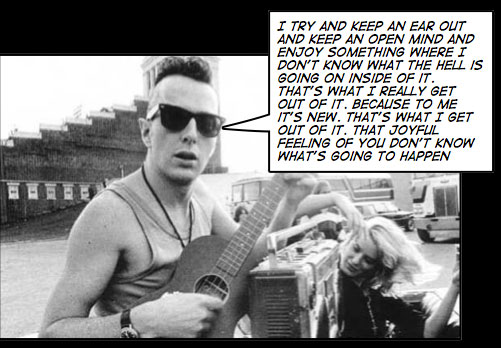
agile planning by joe strummer

As it would have been Joe Strummer's birthday yesterday it seems to be the appropriate point to bring him into the agile planning conversation.


Not that I need an excuse to reference the ever-quotable .


'I try and keep an ear out and keep an open mind and enjoy something where I don't know what the hell is going on inside of it. That's what I really get out of it. Because to me it's new. That's what I get out of it. That joyful feeling of you don't know what's going to happen next...'


imagine the band

As a youngster I made up the same mixtape several times, with several permutations trying to estimate what the 'final' Beatles LP may have been using the best bits from McCartney's solo debut, Lennon's Plastic Ono Band album and George Harrisons All Things Must Pass.

It would have been a corker, for sure.

Knowing also that Lennon/McCartney compositions post-64ish were pretty much written by the individual authors then pasted together or slightly embellished by one or the other, Never Get Out of The Boat favourite and erstwhile acquaintance Go Home Productions has done a decent approximation of what Lennon's Imagine piano riffs and McCartney's Band on the Run words would have produced.


Good to see GHP back after what's been too long an absence...

Also congrats to GHP for helping Weiden Kennedy Amsterdam pick up a Bronze Lion at Cannes, by providing the audio edit with this Heineken film.


Tuesday, August 16, 2011

agile planning by R.M. Rilke


”I would like to beg you dear Sir, as well as I can, to have patience with everything unresolved in your heart and to try to love the questions themselves as if they were locked rooms or books written in a very foreign language. Don’t search for the answers, which could not be given to you now, because you would not be able to live them. And the point is to live everything. Live the questions now. Perhaps then, someday far in the future, you will gradually, without even noticing it, live your way into the answer.”

From R.M. Rilke's letters to a young poet .

René Karl Wilhelm Johann Josef Maria Rilke (4 December 1875 – 29 December 1926), better known as Rainer Maria Rilke, was a Bohemian–Austrian poet. He is considered one of the most significant poets in the German language. His haunting images focus on the difficulty of communion with the ineffable in an age of disbelief, solitude, and profound anxiety: themes that tend to position him as a transitional figure between the traditional and the modernist poets. - from Wikipedia

Friday, August 12, 2011

the competition

Here's a few things that the competition don't do. 

The competition don't buy your product or service. 
The competition don't pay your bills. 
The competition don't reccomend your product or service to friends, colleagues and family. 
The competition don't write positive reviews. 
The competition don't point others to information that help them choose you. 
The competition don't leave positive comments on your website or blog. 
The competition don't wear your t-shirt. 
The competition don't get a tattoo of your logo. 
The competition don't want to participate in helping you improve your product. 
The competition don't share your content/advertising. 
The competition don't participate positively on your Facebook group. 
The competition don't retweet you. 
The competition don't keep buying you when there's cheaper alternatives. 
The competition don't want to connect with other people who support you. 

There's probably loads more things the competition don't do. 

So why do we spend so much time worrying about what the competition is up to, instead of focusing on serving our customers and supporters better?


Thursday, August 11, 2011

if i can dream


This is probably Elvis Presley's finest moment, his performance of 'If I Can Dream' - the jaw-dropping anthemic finale of the 1968 NBC TV Special.

After years in the doldrums of army service, crummy movies and half-baked throwaway hack-pop ditties Elvis reclaimed his position with supreme authenticity, total relevance ('68 USA was still reeling from Vietnam, Watts Riots, JFK, MLK) and pure soul.

This is my only comment on the thoroughly depressing scenes from London, Birmingham, Liverpool and other cities around the UK this week, and the equally depressing knee-jerk reactionary commentary from sections of the blog and twitter-spheres whom I would have thought knew better.

*As an interesting footnote, 'If I Can Dream' was actually written overnight, at the request of Elvis himself the night before the recording of the show,  by Walter Earl Brown as a last-minute replacement for a schmaltzy Christmas number that the Colonel had originally wanted.

Whatever your religious persuasion, if Christmas is a time for closing one year, looking forward to the next with hope, faith in the human spirit and some old fashioned optimism, this song says more about that than I'll Be Home For Christmas, for sure.

We could do with bringing a bit of that forward to August this year.


Tuesday, August 09, 2011

insight lesson from david bowie


In a 2002 interview around his album Heathen David Bowie expressed his frustration at having to continually (over) explain certain nuances related to the project.

In particular the photo on the sleeve in which his eyes are replaced by fish eyes.  

The fish being the secret symbol for Christians avoiding detection in prejudicial circumstances whilst signifying connection with each other. Ergo Heathen.

For those of us who are looking for those signs and symbols in relation to understanding human behaviour, and motivators thereof, as a profession there's a pointer from Dave, with a nod to the escalation of karaoke culture - the prevailing culture in which there is no responsibility, and instant fame/success can be had for little meaningful effort - which was already well underway even back in 2002.

'People are so fucking dumb. Nobody reads anymore, nobody goes out and looks and explores the society and culture that they were brought up in. People have attention spans of 5 seconds and as much depth as a glass of water.'

squirrels are eating your internet

This just in from Gizmodo.
'Level 3 Communications, a major ISP, has a serious beef with squirrels. It turns out the little rodents have a penchant for chewing through their fiber optic lines. They actually account for 17% of the damages to their 84,000 mile network this year.'

PSFK Future Of Retail Report 2011

PSFK Future Of Retail Report 2011 [Preview]
View more presentations from PSFK

The PSFK Future of Retail report is worth a look, even in the edited free version.

They identify 10 key retail trends that sit within 3 broad themes – what they describe as Online Expectations Offline Experience, Shopper Know-How and Redefined Retail Cartography.

A fancy way of describing the new buyer journey as it continues to evolve.

The PSFK team spoke to the people behind many projects that are transforming the shopper experience, including many senior retail and brand executives.

Worth a peek, at least confirm what we are already understanding about retail, it's mobile, social and local. 

The PSFK report in full is also available to purchase with a versioning strategy au naturellement.

Thursday, August 04, 2011

read this before our next meeting

The latest release from Seth Godin's Domino Project is Read This Before Our Next Meeting by Al Pittampalli.
He's on a mission to change the way organizations hold meetings, make decisions, and coordinate action.

I'm there with you, matey.

He calls Outlook/Entourage meeting alerts 'weapons of mass interruption'.

Here's the manifesto:

The Modern Meeting supports a decision that has already been made.
The Modern Meeting starts on time, moves fast, and ends on schedule.
The Modern Meeting limits the number of attendees.
The Modern Meeting rejects the unprepared.
The Modern Meeting produces committed action plans.
The Modern Meeting refuses to be informational. Reading memos is mandatory.
The Modern Meeting works only alongside a culture of brainstorming.


The Modern Meetings Revolution from Al Pittampalli on Vimeo.

For a limited time, the Kindle edition is free...

really crap trainers


Some startling insight from Gary, Tank Commander.
Gary is arguing for the necessity of nuclear weapons.

Many companies are essentially using this same rationale for the adoption of Facebook fan pages and Twitter accounts.

Gary is a fictional comedy character, unfortunately business is in real-life.

Wednesday, August 03, 2011

when is a branded utility not a utility?

When it's a germ magnet.

The Cottonelle toilet roll cover, tin thing. With a lid one has to have to pop off and on before one has washed one's hands.


The broad definition of 'branded utility' being one of 'improving people lives and creating value for the user and the brand'

This?

They didn't think it through, did they?

HT Bud Caddell

proliferating across the earth


Nietzsche's philosophy was regurgitated in a manipulated form by the Nazis in their quest for european/world domination.

Slightly extreme analogy but the message of the digital-social evolution of communications is often regurgitated and manipulated to their own grubby end by the never ending proliferation of social media 'experts' that shows no signs of abating.

Of course with the plethora of sensationalist tech blogs and A-list douchebags to pilfer dogma tweets and content from why bother creating your own stuff? Or cultivating your own point of view?

The process goes INFORMATION > UNDERSTANDING > WISDOM
Getting to wisdom is the goal.

To that point it's worth having a timely reminder of this clip from 2007.
This is a public service post as many of today's social media experts would not have actually been around when this first appeared, anyway.

Tuesday, August 02, 2011

what's up doc?


I spotted this toy in the doctor's surgery the other day.
On first look I was convinced it was a star-jumping Osama Bin Laden in a red sweatshirt and flares.

Flip it and it's actually Bugs Bunny.

Phew.


gerd leonhard: the reinvention of advertising


The here and now of advertising explained concisely by Gerd Leonhard in under 8 minutes.
No mean feat. He makes it look easy.
Send this clip to anyone you know who doesn't get it.

the future is thin and bendy?


'This is the future. Everything is going to look and feel like this within five years,'
says Roel Vertegaal, the director of Queen’s University Human Media Lab and creator of PaperPhone - a flexible smartphone.
'This computer looks, feels and operates like a small sheet of interactive paper.
You interact with it by bending it into a cell phone, flipping the corner to turn pages, or writing on it with a pen.'

'Bend it, bend it just a little bit,
Take it easy, show you're likin' it'

As predicted by Dave Dee, Dozy, Beaky, Mick and Titch.

Monday, August 01, 2011

shiny objects #2356

Once again Olivier Blanchard is one voice of reason well worth paying attention to in the world of digital-social marketing and branding and an antidote to the plethora of social media experts/enthusiasts/pro-retweeters.

He has penned a fairly comprehensive assessment of Google+  which I suggest you have a look at, it includes this paragraph of uncommon sense amongst other wisdom.

'I caution you against drinking anyone’s koolaid. Shiny object syndrome is a major source of noise on the web these days. Tech bloggers make a good living creating content on their blogs with the purpose of attracting as much traffic as possible in order to make as much advertising revenue as possible (and catch the eye of larger media outlets like Mashable, CNN, etc.) So every tech story they can get their hands on has the potential of earning them stacks of cash. The incentive then isn’t to truly analyze or report (or even wait and see), but to sensationalize every new platform release, from Quora to Google Buzz. There is nothing wrong with it, but just be aware of how the web “thought leadership” and content curation bubbles work. A lot of noise doesn’t mean a whole lot except a feeding frenzy of web traffic and incremental revenue. Right now, Google+ is the big story. A while ago, Google Wave was too.'

in search of excellence - 1 tweet summary


Tom Peters, in response to a tweet, summarises his tome In Search of Excellence - and his philosophy, in less than 140 characters. 127 to be precise.

"Cherish your people, cuddle your customers, wander around, 'try it' beats 'talk about it,' pursue excellence, tell the truth."

Whilst Seth Godin once said:
'If you can't state your position in eight words, you don't have a position.'
Even Seth would probably give Tom a pass on this one.